
Gen Z Treats Claude and OpenAI Like Consumer Brands, But AI Detection False Positives Are Still a Trust Problem
Gen Z doesn’t talk about ChatGPT and Claude the way most of us talk about software. They talk about them the way they talk about Nike versus Adidas, or Spotify versus Apple Music. And right underneath that brand loyalty sits a quieter, more personal problem: AI detection false positives, and what happens when a tool built to catch cheaters wrongly accuses someone who did nothing wrong.
I’ve spent enough time watching this shift happen online and working with students and creators dealing with the fallout to know it’s not a small issue. It’s shaping how an entire generation decides which AI tools deserve their trust — and which ones don’t.
[Image placement: Split-image graphic of phone showing a “ChatGPT vs Claude” meme next to a stressed student looking at a laptop. Alt text: “Gen Z comparing AI chatbot brands while worried about AI detection false positives.”]
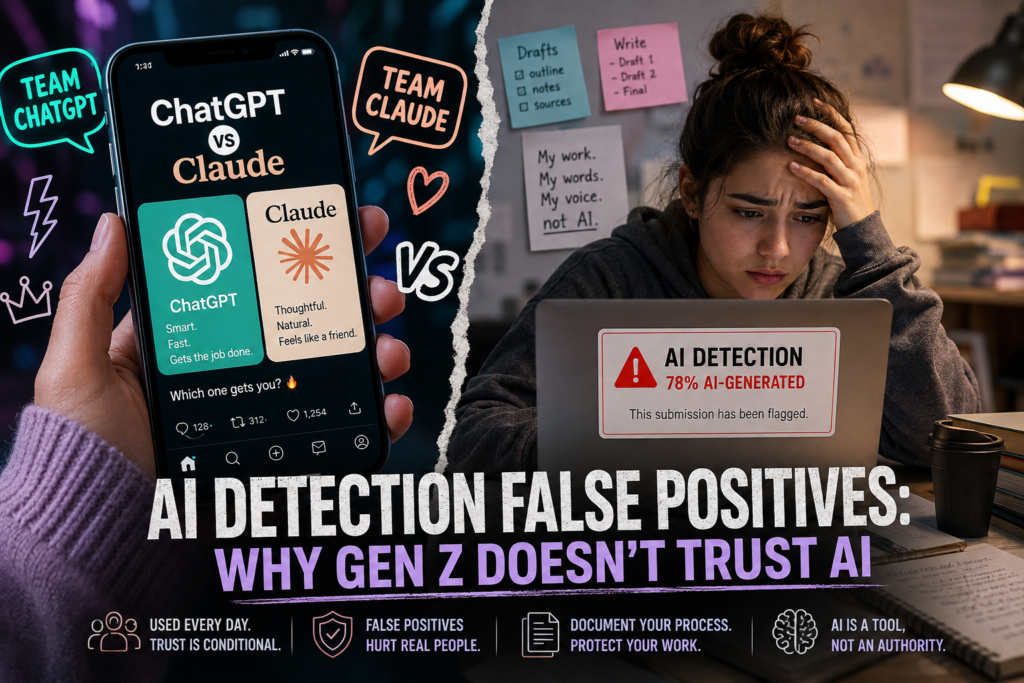
AI Detection false positives : How AI Chatbots Became Consumer Brands for Gen Z
The shift clicked for me the moment “ChatGPT said…” started showing up in casual conversation the same way “my Nikes” or “my AirPods” would. People weren’t describing a tool anymore. They were describing a relationship.
On TikTok and Instagram, this shows up in a few consistent ways:
- Personality comparisons. Users debate whether Claude “sounds” warmer or more thoughtful than ChatGPT, the same way someone might compare two friends’ communication styles.
- Preference-based loyalty. People pick a favorite chatbot and defend it, almost like a sports team or a phone brand.
- Memes as brand identity. Once a tool becomes meme-able, it’s no longer just software. It has a reputation, quirks, and a fanbase.
AI detection false positives : For me, that’s what made it make sense. Once something becomes a joke people share, it’s already a brand in the cultural sense — whether the company intended that or not.
The Trust Problem: Why AI Detection False Positives Matter
Here’s where the brand-loyalty story runs into a harder truth. Gen Z isn’t just choosing an AI chatbot the way they’d choose a sneaker. They’re also being judged by AI — through detection tools — in ways that carry real academic and professional consequences.
AI detection false positives happen when a detector incorrectly flags human-written work as AI-generated. For a student, that’s not an abstract technical glitch. It’s a moment where they suddenly have to prove that their own writing is, in fact, their own.
This isn’t a rare edge case, either. Turnitin, one of the most widely used academic AI detectors, has publicly acknowledged that its tool can misidentify human writing, and it specifically warns of a higher incidence of false positives when the AI-writing percentage falls between 0 and 19%. The company has said its AI-writing result should not be used as the sole basis for taking action against a student.AI detection false positives.
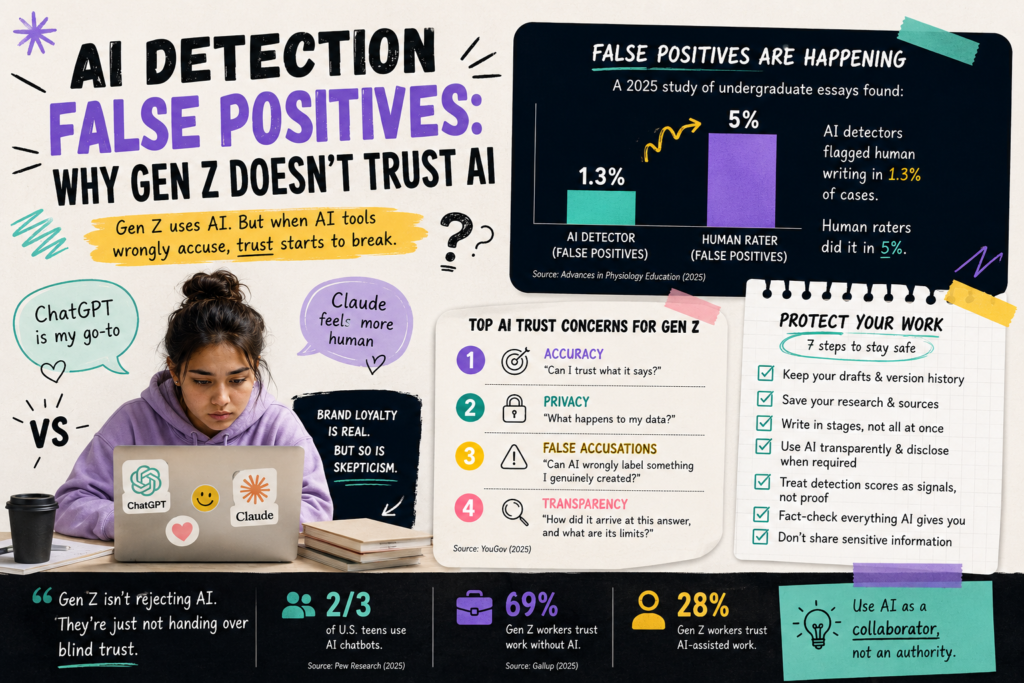
Independent research backs this up. A 2025 study of undergraduate anatomy and physiology essays found that roughly 1.3% of genuinely human-written essays were misclassified as AI-generated by the detectors tested, compared with a 5% false-flag rate among human raters doing the same job manually. That might sound like a small number, but scaled across millions of student submissions, it’s a lot of real people getting wrongly accused.
I want to be careful here: I’m not claiming I personally watched a specific student get flagged and cleared. What I am saying, based on the documented cases and research above, is that this scenario is very real and increasingly common — and it’s exactly the kind of experience that makes Gen Z hesitant to fully trust AI systems, even the ones they use every day. AI detection false positive.
[Image placement: Simple bar chart showing false-positive rates from the physiology study (1.3% detector vs. 5% human rater). Alt text: “Graph illustrating the disparity in false positives between automatic AI detection systems and human evaluators.
What Gen Z Actually Worries About (Ranked)
Trust issues with AI aren’t one-dimensional. Based on what I’ve seen and what recent survey data shows, here’s roughly how the concerns stack up for Gen Z and AI users more broadly:
| Rank | Concern | What It Sounds Like |
| 1 | Accuracy | “Can I trust what it says?” |
| 2 | Privacy | “What occurs to the data I provide? “ |
| 3 | False accusations / AI detection | “Can AI wrongly label something I genuinely created?” |
| 4 | Transparency | “How did it arrive at this answer, and what are its limits?” |
That ranking isn’t a guess. A recent YouGov survey found that accuracy was the top concern for 59% of AI users, with privacy close behind at 49%. Interestingly, the same research found trust actually increases with familiarity — avid AI users trust the technology more than occasional users do, which suggests skepticism often comes from unfamiliarity as much as bad experiences.
What makes the AI detection false-positives issue different from a simple wrong answer is that it feels personal. If a system can confidently mislabel someone’s own original work, it raises a bigger question: should this system get to judge people at all?
AI detection false positives : Gen Z isn’t rejecting AI over this, though. According to Pew Research, around two thirds of U.S. teens report using AI chatbots, including about three in ten who use them daily. At the same time, Gallup found a striking gap in workplace trust: Gen Z workers place far more trust in work completed without AI (69%) than in AI-assisted work (28%).
So the honest summary is this: Gen Z uses AI constantly, but they’re not handing over blind trust. It’s more like, “I’ll use it, but I’m not going to blindly trust it.”
A Practical Framework: Protecting Yourself From False AI Detection Flags
If you’re a student, creator, or professional who wants to avoid getting caught in an AI detection false positive, the goal isn’t to “beat” the detector. It’s to build a paper trail that proves your work is genuinely yours.
- Keep your drafts. Save outlines, notes, and earlier versions. Version history in Google Docs or Word is one of the strongest pieces of evidence you can have.
- Keep your research trail. Hold onto the sources, screenshots, and references you actually used while writing.
- Write in stages. Producing a piece across multiple sittings creates a visible progression that’s much harder to dispute than a single finished file.
- Use AI transparently. If you use ChatGPT or Claude for brainstorming, grammar checks, or feedback, know your school or client’s policy and disclose it when required.
- Treat detection scores as signals, not proof. Even Turnitin says its score alone shouldn’t be the basis for accusing a student of misconduct.
- Fact-check anything AI gives you. Names, statistics, citations, and legal or academic claims especially — AI can sound confident while being wrong.
- Don’t share sensitive information unnecessarily. Strip out personal, confidential, or proprietary details unless you fully understand a tool’s privacy settings and have permission to share them.
The mindset that actually works here is treating AI as a collaborator, not an authority. Use it to generate ideas or sharpen a draft, but keep your own judgment — and your own paper trail — in the driver’s seat.
If you do get flagged, resist the urge to panic-rewrite everything just to lower a detector score. Instead, show your drafts, your version history, your research notes, and explain your actual process. That’s far more convincing than anything a detector percentage can offer.
[Image placement: Simple checklist graphic listing the 7 steps above, styled like a students’ desk with sticky notes. Alt text: “Gen Z comparing AI chatbot brands while worried about AI detection false positives.”]
Where This Trust Relationship Is Headed
My honest take: Gen Z’s trust in AI brands like Claude and ChatGPT will keep growing, but it’s not going to become blind trust — and I think that’s healthy.
The AI detection false positives false-positive issue is a good example of why. When a confident system can still get things wrong, people learn quickly that confidence doesn’t equal accuracy. That lesson doesn’t go away just because someone keeps using the tool daily.
If AI companies get better at accuracy, communicate limitations clearly, protect user data, and take responsibility when systems make mistakes, trust will likely strengthen over time. If they keep making confident mistakes — or let AI detection false positives function like an automated accusation — the skepticism will stay baked in.
The future here isn’t blind trust. It’s informed trust. AI detection false positives : Gen Z will keep using AI, but they’ll increasingly judge these tools by whether the tools earn that trust, rather than expecting it to be handed over automatically.
FAQs
What is an AI detection false positives? It’s when an AI detection tool incorrectly flags human-written content as AI-generated, even though a person wrote it themselves.
How common are AI detection false positives? Rates vary by tool and writing style, but research on undergraduate essays found a false-positive rate of about 1.3% from automated detectors — and some independent testing has found higher rates depending on the tool and the type of writing involved.
Can a false AI detection flag hurt my grades or reputation? Yes, it can, which is why most detection companies, including Turnitin, now advise that a score alone should never be the sole basis for disciplinary action.
How do I prove my writing is genuinely mine? Keep drafts, version history, research notes, and write in stages. That kind of process evidence is far stronger than arguing with a detection score after the fact.
Does Gen Z trust AI chatbots like Claude and ChatGPT? They use them heavily, but trust is conditional. Most Gen Z users are comfortable using AI daily while remaining skeptical of its accuracy and how it’s used to judge their work.
Final Takeaways
Gen Z’s relationship with AI brands like Claude and ChatGPT looks a lot like brand loyalty on the surface — personality debates, memes, preferences. But underneath that familiarity is real skepticism, and AI detection false positives are one of the clearest reasons why.
If you’re a student or creator, don’t wait until you’re flagged to start protecting yourself. Save your drafts, document your process, and treat every detection score as a starting point for a conversation, not a verdict. For a deeper look at how detection tools actually work under the hood, see our guide to how AI writing detectors score your content for more context on the mechanics behind these percentages.
Suggested external references:
- Turnitin, “Understanding False Positives Within Our AI Writing Detection Capabilities” — https://www.turnitin.com/blog/understanding-false-positives-within-our-ai-writing-detection-capabilities
- Advances in Physiology Education, “Using aggregated AI detector outcomes to eliminate false positives in STEM-student writing” — https://journals.physiology.org/doi/full/10.1152/advan.00235.2024
- Pew Research Center, “Teens, Social Media and AI Chatbots 2025” — https://www.pewresearch.org/internet/2025/12/09/teens-social-media-and-ai-chatbots-2025/
- Gallup, “Gen Z’s AI Adoption Steady, but Skepticism Climbs” — https://news.gallup.com/poll/708224/gen-adoption-steady-skepticism-climbs.aspx
- YouGov, “Most Americans use AI for quick answers, but avid users trust it more” — https://yougov.com/en-us/articles/53214-most-americans-use-ai-for-quick-answers-but-avid-users-trust-it-more
Video/embed suggestion: Embed a short (under 2-minute) TikTok or Reels compilation of “ChatGPT vs Claude personality” memes to visually reinforce the brand-loyalty section — helps with dwell time and matches the topic naturally.
Welcome to WordPress. This is your first post. Edit or delete it, then start writing!
AI detection false positives
Hi, this is a comment.
To get started with moderating, editing, and deleting comments, please visit the Comments screen in the dashboard.
Commenter avatars come from Gravatar.